
A Return for Progress? A Glance at the Government of Malawi’s First Six Months Back in Office
Written by Thokozani Galaffa and Eddah Jowah
Introduction
In Malawi, we started tracking government performance through the Malawi Citizens Watch Platform (2020-2025) when President Lazarus Chakwera was elected to office. After the 2025 elections, we continued to track the Government of Malawi’s performance, focusing on the new government under Professor Arthur Peter Mutharika. This report provides insight into how the Government of Malawi has performed in the first six months since the elections.
Background
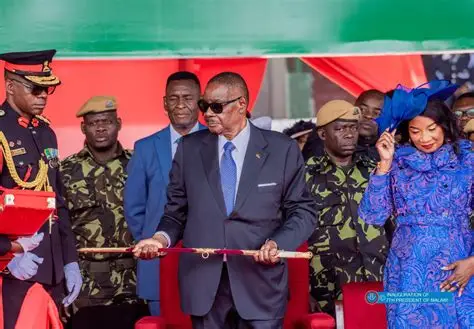
In a historic return to power, Malawians re-elected President Arthur Peter Mutharika of the Democratic Progressive Party (DPP) into power in the 16 September 2025 elections. This was after an unsuccessful bid for a second term in 2019 that led to the DPP being out of government for 5 years. Winning 56.8% of the votes, Mutharika replaced Lazarus Chakwera of the Malawi Congress Party (MCP). On 4 October 2026 Mutharika was inaugurated for his second term as president.
Manifestos and Promises
In the run-up to elections, different political parties presented their manifestos to Malawians, reflecting their plans and promises for the next five (5) years (2025-2030). A total of seventeen (17) candidates contested in the presidential elections, each with their own set of promises made to the citizenry. We are committed to following up on government promises through the African Citizens Watch (ACW), an independent platform tracking the performance of governments in Malawi, Zambia, Zimbabwe, South Africa and Botswana. The tracking work focuses on government actions and policy decisions against promises as presented in the manifestos of the governing party, to enhance government accountability as well as citizen participation in democracy.
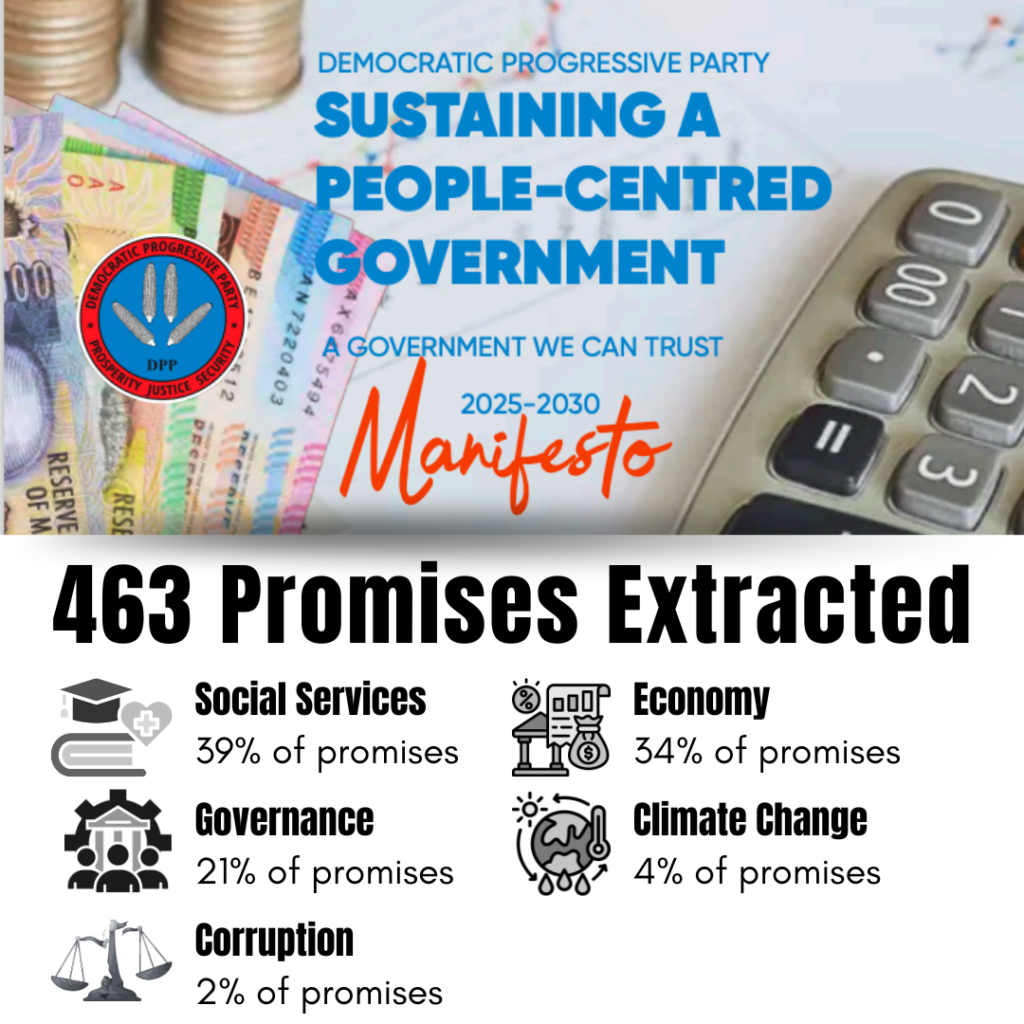
Our analysis of the DPP manifesto extracted and consolidated 463 promises that the party committed to deliver to the citizens of Malawi. These promises have been categorised into five (5) sectors:
- Economy
- Social Services
- Governance
- Corruption
- Climate Change
How Do We Track?
After tracking the performance of the previous government led by President Lazarus Chakwera from 2020 to 2025[1], the same work continues as we track the extent to which the new government is working to deliver on their commitments to citizens through the Malawi Citizens Watch platform. Through credible sources such as online media publications and official government records, we have been closely monitoring government policy decisions and actions regarding these promises since the day of President Arthur Peter Mutharika’s inauguration. It is worth noting that the Malawi Citizens Watch tracker only records published developments that the government has had a direct hand in; unpublished actions are not recorded. For Malawi, the promises together with the corresponding actions and information sources are uploaded on the Tracker. Based on the actions being taken by the government, the promises are rated as either Implemented (completed to full capacity), In Progress (actions taken towards fulfilling the promise but not to full capacity), Not commenced (no actions taken yet), Modified (promise changed due to other circumstances) and Broken (government actions that are contrary to initial promise).
What has happened in the first 6 months?
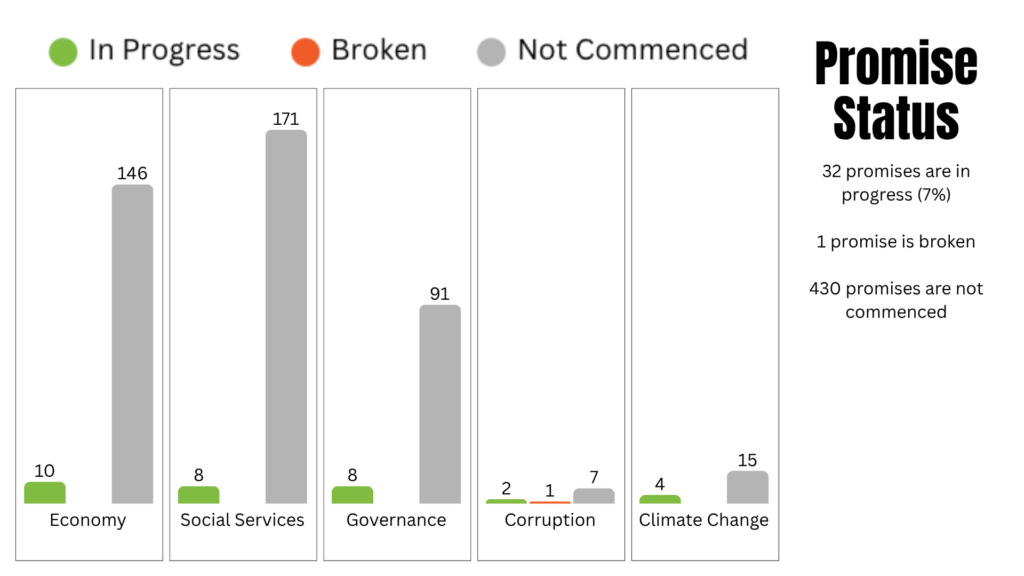
Out of the 463 promises, thirty-two (32) have commenced and are in progress; 430 have not yet commenced, while one (1) has been broken.
Sectoral Analysis

Economy
Economy constitutes 34% of all the DPP manifesto promises, and it covers the following thematic areas: Financial Management; Agriculture and Rural Development; Trade; Mining; Transport and Infrastructural Development; Energy; Job Creation; Tourism; Industry and Commerce; as well as Information Communication Technology (ICT).
To date, out of the 156 promises under Economy, 10 (representing 6.4%) are in progress, and none have been fully implemented. Seven (7) of those 10 promises that are in progress have focused on financial management. Data collected on the Tracker this far shows that the first six (6) months of DPP-led government have predominantly focused on addressing the country’s economic challenges, increasing revenue through tax-base widening measures and reducing public expenditure. Although there is still a long way to go to achieve economic stabilisation for Malawi, there has been some notable progress.
Key Highlights:
- Improved budget performance. During these first 6 months, the government has recorded an improvement in revenue collection attributed to expanded tax measures (increased value-added tax (VAT) from 16% to 17.5%; changed Pay As You Earn (PAYE) bracket to start from MK170,000 (US$98)[2] shielding the low income earners but extending the amount paid by those earning above MK10 million (US$5,736) to 40% of their income; and introduced a 0.05% levy on all money transfers). This is in line with the promise of improving domestic revenue mobilisation through widening the tax base.
- Drop in inflation from 26% at the end of 2025 to 24.9% by February 2026. This has mainly been attributed to the drop in the price of maize, which is the country’s staple food. The government’s decision to import around 200,000 metric tons of maize from Zambia increased supply on the local market, pushing prices down. This contributes to government’s promise of bringing down inflation to single digits.
- The DPP also promised to set the monetary policy rate at a level consistent with real interest rates to tame inflation. The Reserve Bank’s decision to reduce the Policy rate from 26% to 24% appears to be a step in the direction of this promise.

Social Services
Promises under the Social Services sector make up the majority of the DPP promises (39% of the total promises), covering: Education; Health; Water and Sanitation; Land Tenure and Human Settlements; Public Safety; Housing; Service Delivery; Youth and Women Empowerment; Sports and Arts; Child Protection; Social Protection. Out of the 179 promises made, none have been fully implemented, while eight (8) are in progress.
Key Highlights:
- On the 2nd January 2026, the President abolished the collection of school development fees and other user fees in all public secondary schools as part of his promise towards the implementation of free secondary education.
- In relation to the promise to clear out bottlenecks affecting pensioners’ access to their gratuity, the government commenced the payment of overdue pensions and gratuities in January of 2026 following parliament approval of an additional MK196 billion (US$108 million)[3] in the 2025/26 mid-year budget review.

Governance
Under governance, the DPP made 99 promises representing 21% across the following areas: Administration; Rule of Law; National Security; Foreign Policy; Cost Cutting; Transparency and Accountability; Women Empowerment; Justice for All; Information Communication and Technology (ICT); and Nation Building. Out of the 99 promises, eight (8) are in progress while 91 remain not commenced.
Key Highlights:
- The government of Malawi has increased the Constituency Development Fund (CDF) allocation to MK5 billion (over US$2.8 million) per constituency for the 2026/27 budget. This is one of the key promises that the government made under governance and was one of the most popular promises during the campaign period.
- Among the DPP’s promises was the plan to relocate Malawi Communications Regulatory Authority (MACRA), Malawi Housing Corporation (MHC) and other offices from the capital city, Lilongwe to Blantyre City and five (5) days into office, the President ordered that the headquarters of MACRA and MHC return to Blantyre, while Malawi Prison Service headquarters return to Zomba.
- As part of its promise to cut operational costs, the government announced austerity measures on 6 November 2025, aimed at reducing fiscal expenditure (in line with its promise). Among these measures is the freeze on the purchase of new government vehicles for public officials and the reduction of trips for cabinet ministers.

Corruption
A total of 10 (2%) of the promises made by the DPP deal with issues of corruption. Out of the 10 promises, two (2) are in progress, while one (1) has been broken.
Key Highlights:
- While the DPP government promised to ensure the investigation and prosecution of the corruption cases that had stalled in the last five (5) years, its decision to discontinue and withdraw criminal cases involving some key government officials (as reported by the Mail & Guardian as well as Maravi Post) goes against this promise.
- On the other hand, the Anti-Corruption Bureau’s arrests of suspects in the Green Belt Authority corruption case and the Financial Intelligence Authority’s freezing of the accused’s accounts show a level of progress towards the promise to prioritize recovery of funds from perpetrators of financial crimes.

Climate Change
There are 19 promises under Climate Change (4% of the total promises). Out of this, four (4) are in progress, while none have been fully implemented.
Key Highlights:
- Towards its promise of eliminating the use of thin plastics, the government has strengthened enforcement of the ban on the production and use of single-use plastics.
- The DPP also promised stringent air, water, and chemical pollution regulations as one way of addressing environmental challenges. In January 2026, the Malawi Environment Protection Authority (MEPA) ordered Presscane Limited to stop operations at its premises in Chikwawa district for contaminating both people and natural resources in the surrounding communities with effluent spillage. The company was also ordered to compensate people in the surrounding communities whose lives had been put at risk because of the unmanaged spillage.
Conclusion
In the first six (6) months back to office, the Government of Malawi has made progress towards fulfilling 32 out of the 463 promises made in the DPP election Manifesto. One (1) promise has been broken. Most of the progress made has been in the economy and governance. The social services cluster, though constituting a major part of the promises, has not recorded much progress. It is still early days, and tracking will continue for the next four and a half years. Updates on the performance can be accessed through the Malawi Citizens Watch Tracker on https://africancitizenswatch.org/malawi.
[1] 2025 Malawi Barometer Report
[2] USD/MK1743.4 US Dollar (USD) to Malawi Kwacha (MWK) 2025 Historical Exchange Rates
[3] USD/MWK1743.4 US Dollar (USD) to Malawi Kwacha (MWK) 2025 Historical Exchange Rates