Citizens asked for jobs, water and safety.
What did the political parties promise?
Manifesto analysis for South Africa’s local government elections
Date Published: 29 October 2026
Citation: Xali, A. & Cross, R. (2026). Citizens asked for jobs, water and safety. What did the parties promise? SIVIO Institute.
Local government elections are being held on Wednesday, 4 November 2026, in South Africa. These elections will determine who governs the country’s municipalities, with more than 136,790 candidates from 547 political parties contesting the elections.
Through our African Citizens Watch initiative, SIVIO Institute has consistently sought to understand whether political parties promises reflect the needs and expectations of citizens. As South Africans prepare to vote, we wanted to ask a simple question: What are political parties promising, and how do these promises relate to what citizens want?
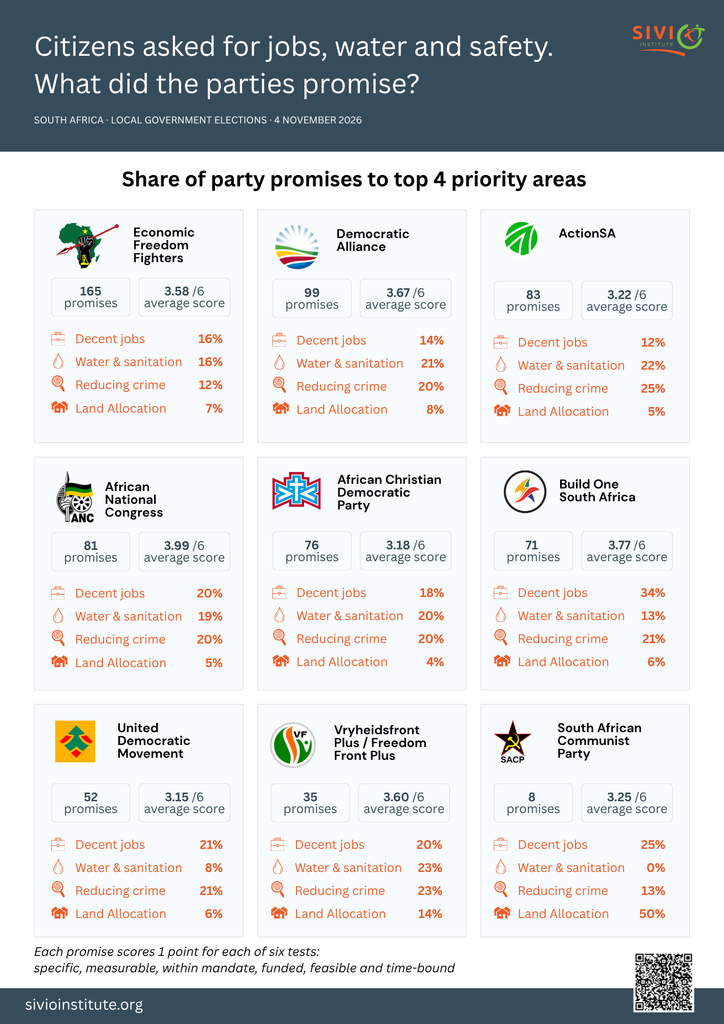
We went through the manifestos of 9 political parties and found 670 commitments to the citizens of South Africa. Economic Freedom Fighters (EFF) made 165 promises, the Democratic Alliance (DA) made 99, and the South African Communist Party made 8. We then analysed these commitments on two levels.
- Are they addressing the top priorities for citizens? These include decent jobs, clean water and sanitation, reducing crime and land allocation.
- What about the quality of the promises? We assessed each commitment against six criteria, whether it was:
- Specific?
- Measurable?
- Feasible and achievable within the term limit?
- Within the municipal mandate?
- Supported by financing or resource information?
- Time-bound?
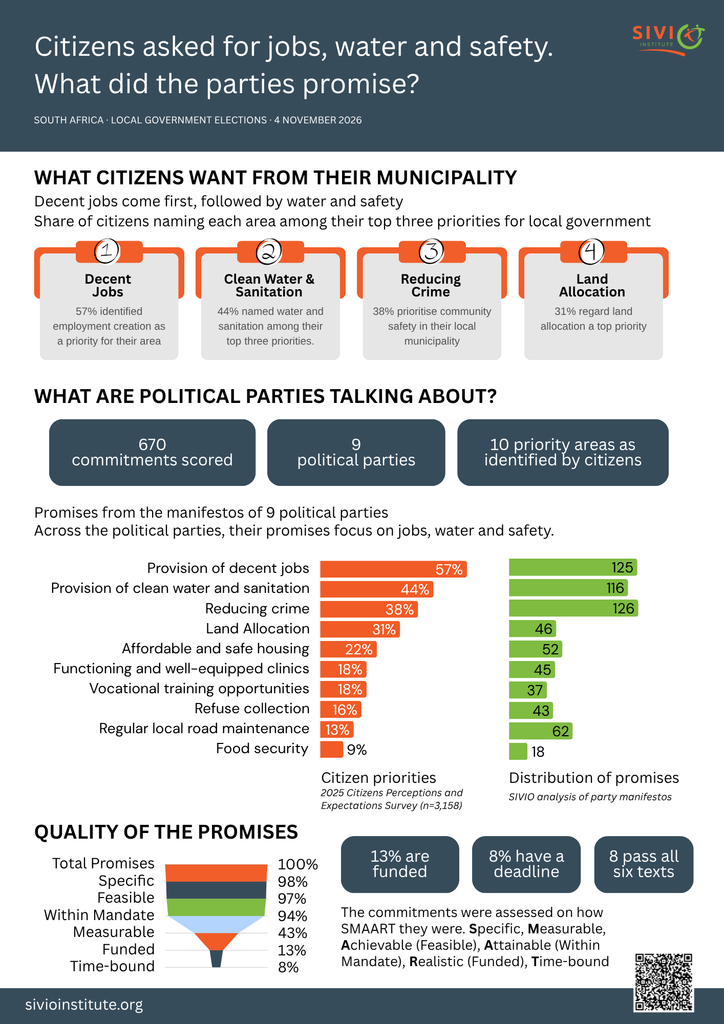
Through our 2025 Citizens’ Perceptions and Expectations (CPE) Survey, citizens told us that they want decent jobs, clean water and safer communities. These priorities are also prominent in the manifestos analysed, with 126 commitments on crime reduction, 125 on decent jobs and 116 on clean water and sanitation.
But how clear are political parties about delivering on these promises?
Our analysis found that while 98% of commitments were specific, only 43% were measurable, 13% identified financing or resources, and just 8% provided clear timeframes.
This suggests that political parties are largely addressing issues that matter to citizens, but many of their commitments leave important questions unanswered about how progress will be measured, what resources will be required and when delivery can be expected.
Our short report presents the key findings, while the new Priorities vs Promises dashboard allows anyone to explore the commitments in greater detail, by political party and priority area.
As South Africans prepare to vote, the analysis provides an opportunity to look beyond what political parties are promising and ask how those promises will be delivered. After the elections, these commitments can also serve as a starting point for monitoring progress and holding elected representatives accountable.
The promises are now on record. The next question is what happens to them after the election.
How we did it?
We assessed 670 commitments from the 2026 local government election manifestos of nine political parties: the African Christian Democratic Party (ACDP), ActionSA, African National Congress (ANC), Build One South Africa (BOSA), Democratic Alliance (DA), Economic Freedom Fighters (EFF), South African Communist Party (SACP), United Democratic Movement (UDM) and Vryheidsfront Plus (VF Plus).
Each commitment was assessed against six criteria: whether it was specific, measurable, within the municipal mandate, supported by financing or resource information, and feasible and time-bound. Each criterion was awarded one point, giving every commitment a possible score out of six.
We also classified commitments as pro-poor, pro-market, hybrid or populist to understand the different approaches political parties take to addressing local economic and social challenges.
Citizens’ priorities were drawn from SIVIO Institute’s 2025 Citizens’ Perceptions and Expectations (CPE) Survey, in which 3,158 South Africans identified their top three priorities for local government. Information on where political parties are contesting elections was drawn from the Electoral Commission of South Africa’s (IEC) certified candidate list.
The analysis focused on nine political parties whose manifestos were publicly available at the time of the assessment. The analysis excluded some political parties, including the MK Party, Inkatha Freedom Party (IFP), and Patriotic Alliance (PA), because their manifestos had either not yet been launched or could not be accessed online when the analysis was conducted.